The Stamp Act was one of the earliest and most controversial attempts by the British government to raise revenue directly from its American colonies. Enacted in 1765, the law required that many printed materials e.g., legal documents, newspapers, pamphlets, licenses, and even playing cards etc., carry an official stamp purchased from British authorities. This stamp served as proof that a tax had been paid. Whilst the measure might appear modest in financial terms, its political and symbolic significance was enormous, and its repercussions would help set in motion the chain of events that ultimately led to the Boston Massacre.
To understand the Stamp Act, it is necessary to consider the context in which it was introduced. Britain had emerged victorious from the French and Indian War (1754–1763), but the war had left the nation with a massive debt. Maintaining a standing army in North America to defend newly acquired territories and manage relations with Indigenous nations was also costly. British policymakers believed it was both reasonable and necessary for the colonies to contribute more directly to these expenses. From their perspective, the colonies had benefited from British military protection and should share the financial burden of empire.
The Stamp Act represented a shift in how Britain approached colonial taxation. Previous measures had largely been indirect, such as customs duties on imported goods. The Stamp Act, however, was a direct internal tax, imposed not on trade but on everyday transactions within the colonies. This distinction mattered greatly to colonists, who had long accepted Parliament’s authority to regulate trade but rejected its right to levy internal taxes without their consent. Colonial assemblies had traditionally held the power to tax their own populations, and the Stamp Act appeared to bypass and undermine these local institutions.
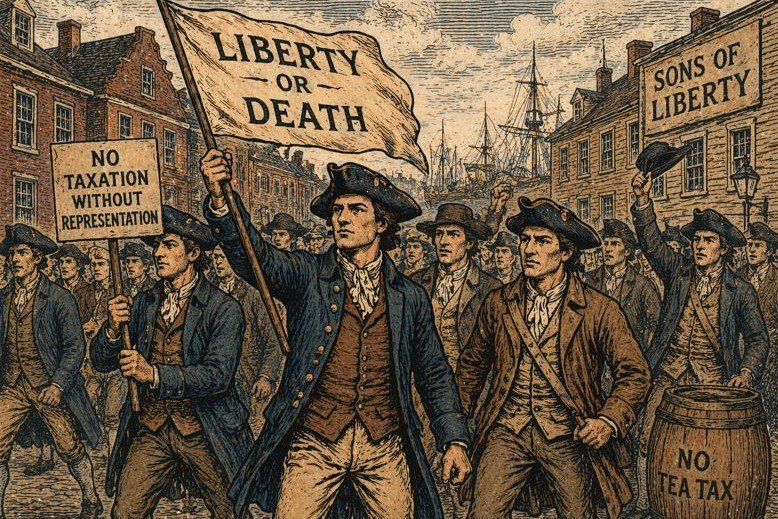
The reaction in the colonies was swift and intense. Opposition emerged across social classes, uniting merchants, lawyers, printers, and laborers in a shared sense of grievance. Central to this resistance was the argument that the Act violated the principle of “no taxation without representation.” Colonists argued that, as British subjects, they were entitled to the same rights as those living in Britain, including the right to be taxed only by their elected representatives. Because they had no direct representation in Parliament, they viewed the Stamp Act as an unconstitutional imposition.
Organized resistance played a crucial role in the Act’s eventual failure. Groups such as the Sons of Liberty emerged to coordinate protests and enforce boycotts of British goods. Demonstrations sometimes turned violent, with tax collectors targeted and effigies burned in the streets. In Boston, crowds intimidated officials into resigning, effectively preventing the Act from being enforced. At the same time, colonial leaders convened the Stamp Act Congress in 1765, which petitioned the Crown and Parliament for repeal.
Facing economic pressure from colonial boycotts and growing unrest, Parliament repealed the Stamp Act in 1766. However, this repeal was accompanied by the Declaratory Act, which asserted Parliament’s authority to legislate for the colonies “in all cases whatsoever.” whilst the immediate crisis subsided, the underlying conflict remained unresolved. The experience of resisting the Stamp Act had lasting effects: it strengthened networks of opposition, sharpened political arguments about rights and representation, and demonstrated that collective action could force Britain to change course.
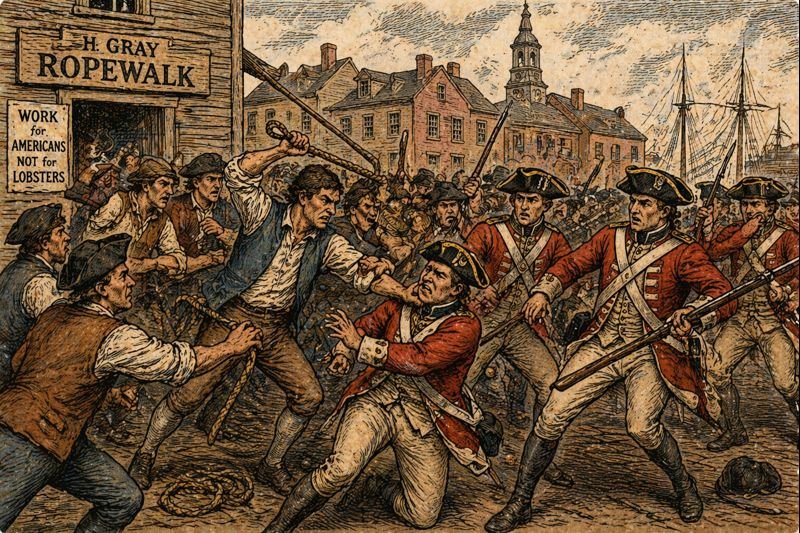
In the years that followed, these tensions continued to build. New measures, including the Townshend Acts, reignited disputes over taxation and authority. Boston became a focal point of resistance, with protests, boycotts, and political organizing intensifying. The British response, sending troops to the city in 1768 to enforce order, only deepened the crisis. For many colonists, the presence of soldiers was a direct consequence of earlier conflicts like the Stamp Act, representing an attempt to impose compliance through force.
The legacy of the Stamp Act can be seen clearly in the events leading up to the Boston Massacre. The Act had helped transform colonial attitudes toward British authority, turning what might have been seen as isolated policy disagreements into a broader struggle over rights and governance. It also contributed to the rise of organized resistance and the politicization of everyday life. By 1770, disputes over taxation were no longer abstract constitutional arguments but lived realities, affecting employment, public order, and relations between civilians and soldiers.
When violence erupted on March 5th, 1770, it did so in a city already shaped by years of conflict over taxation and representation. The anger directed at British soldiers was not simply the result of a single incident but the culmination of a series of grievances that had been building since the Stamp Act. In this sense, the Act played a foundational role in the chain of events that led to the massacre. It marked the beginning of a new phase in colonial resistance, one in which questions of authority, rights, and identity would increasingly come to the forefront.
Although the Stamp Act itself was short-lived, its impact was enduring. It introduced ideas and patterns of resistance that would define the revolutionary era, helping to set the stage for the dramatic confrontations that followed.