Crispus Attucks
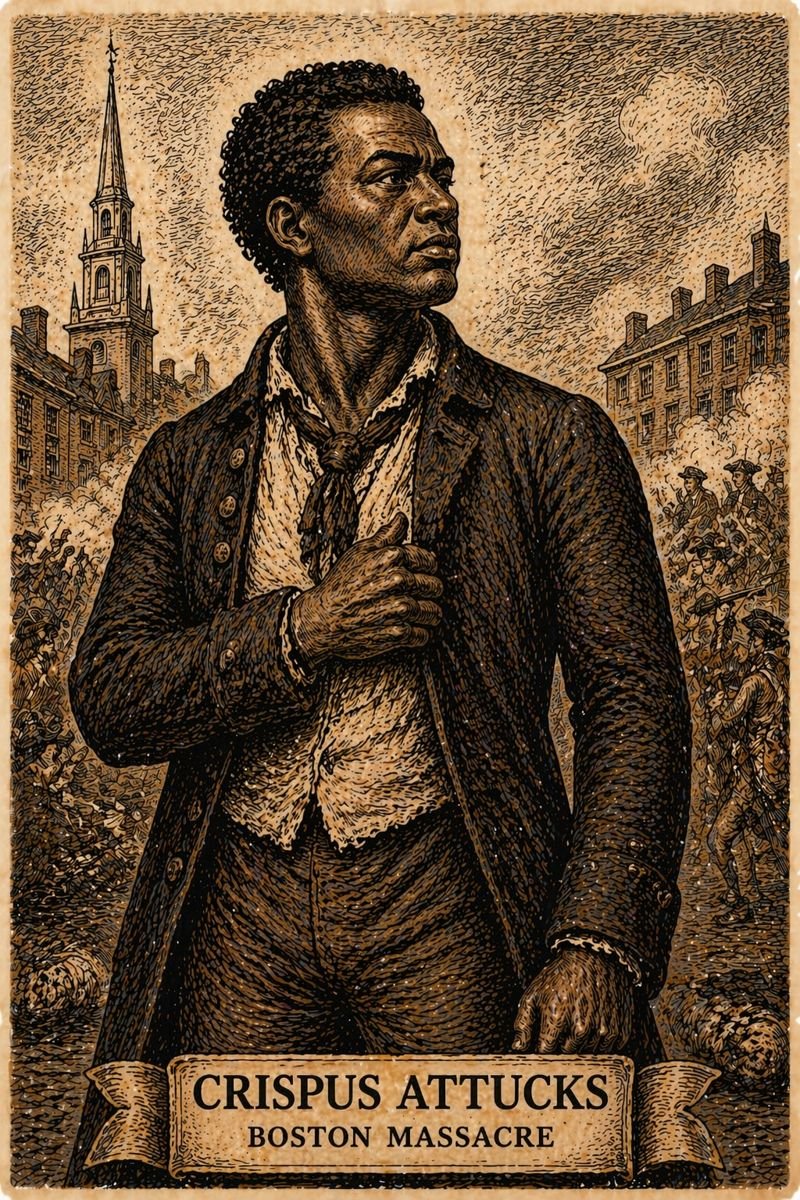 Crispus Attucks holds a distinctive place in American history as one of the first individuals killed in the Boston Massacre and, by
extension, one of the earliest casualties of the American struggle against British rule. His death on March 5, 1770, gave a human face to the
growing conflict between colonists and imperial authority, and over time he came to symbolize both resistance and the diverse makeup of the
colonial population.
Crispus Attucks holds a distinctive place in American history as one of the first individuals killed in the Boston Massacre and, by
extension, one of the earliest casualties of the American struggle against British rule. His death on March 5, 1770, gave a human face to the
growing conflict between colonists and imperial authority, and over time he came to symbolize both resistance and the diverse makeup of the
colonial population.
Attucks is believed to have been of mixed African and Native American descent, possibly Wampanoag, though details of his early life remain somewhat uncertain. He is thought to have been born into slavery in Massachusetts in the early 18th century and may have escaped bondage as a young man. By the time of the Boston Massacre, he was working as a sailor and dockworker (stevedore), occupations that were common for men living on the margins of colonial society. This background placed him among the working-class population of Boston; individuals who were often most directly affected by economic hardship and political instability.
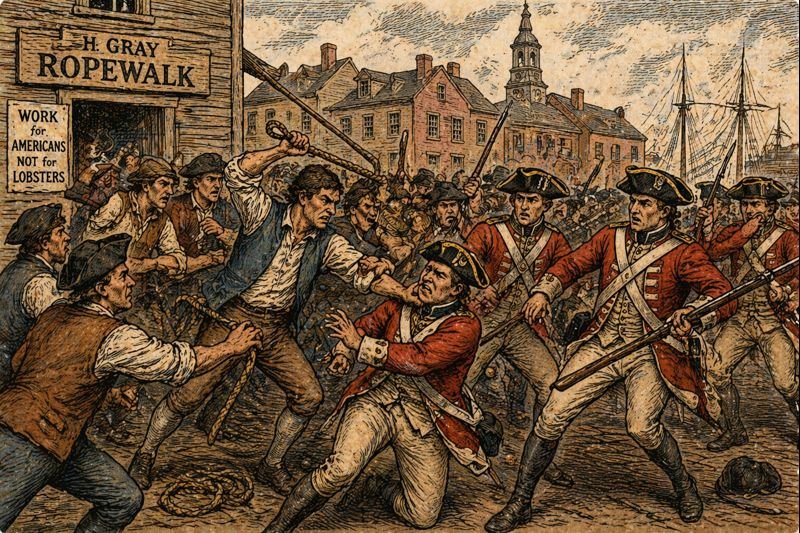
On the night of the massacre, Attucks was part of the crowd that gathered on King Street, drawn by the escalating confrontation between colonists and British soldiers. While accounts differ regarding his exact actions, several contemporaneous testimonies suggest that he was near the front of the group and actively engaged in the confrontation. When British troops fired into the crowd, Attucks was struck and killed, reportedly by two musket balls. His death, along with that of four other colonists, quickly became central to how the event was remembered and interpreted.
In the immediate aftermath, Attucks’s role was somewhat contested. During the trial of the British soldiers, defense attorneys, including John Adams, portrayed him as a leading and potentially provocative figure within the crowd, arguing that the soldiers had been threatened and acted in self-defense. This depiction was part of a broader legal strategy aimed at mitigating the soldiers’ responsibility. At the same time, patriot leaders and propagandists emphasized the innocence of the victims, including Attucks, presenting them as martyrs to British aggression.
Over time, Attucks’s significance grew. In the decades following the American Revolution, and particularly in the 19th century, he was increasingly celebrated as a symbol of sacrifice and patriotism. His identity as a man of African descent took on added importance, especially for abolitionists and later civil rights advocates, who pointed to his role in the founding struggle as evidence of the contributions made by African Americans to the nation’s history.
Attucks’s story also highlights the broader dynamics of the period. The Boston Massacre was not solely an event driven by elite political figures; it involved ordinary people, many of whom lived precarious lives shaped by economic inequality and limited opportunity. As a sailor and laborer, Attucks represents this often-overlooked dimension of the revolutionary movement, where working-class individuals played a crucial role in both protest and resistance.
Today, Crispus Attucks is remembered as more than just a victim of the Boston Massacre. He stands as a figure whose life and death reflect the complexities of colonial society, its inequalities, its injustice, and its aspirations. His legacy endures as a reminder that the path to independence was shaped not only by famous leaders but also by individuals whose stories continue to resonate in discussions of justice, equality, and national identity.
Thomas Preston
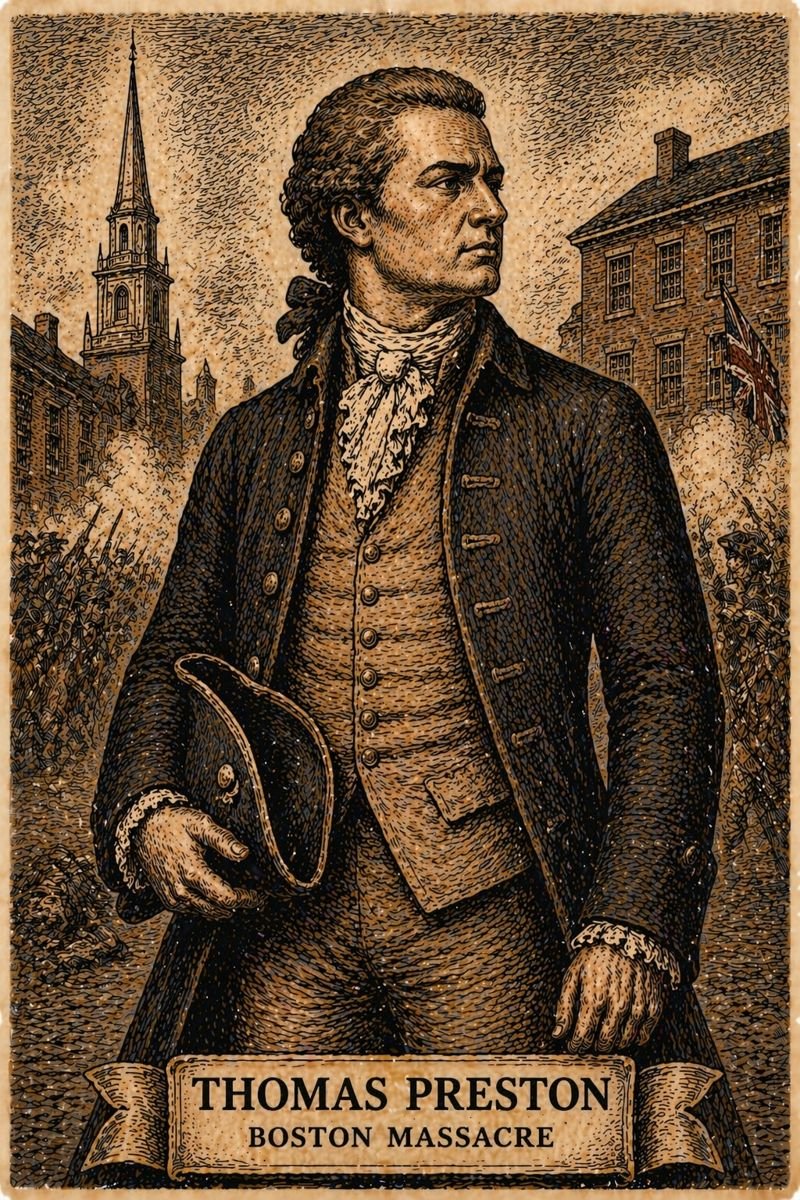 Thomas Preston was a central figure in the events of the Boston Massacre, not because he initiated the violence, but because of his role as the commanding
officer present when tensions erupted into deadly force. As a captain in the British Army, Preston found himself at the intersection of military duty and civilian
unrest in a city already on edge, and his actions both real and perceived actions, became critical to how the incident was understood.
Thomas Preston was a central figure in the events of the Boston Massacre, not because he initiated the violence, but because of his role as the commanding
officer present when tensions erupted into deadly force. As a captain in the British Army, Preston found himself at the intersection of military duty and civilian
unrest in a city already on edge, and his actions both real and perceived actions, became critical to how the incident was understood.
On the evening of March 5th, 1770, Preston responded to a call for assistance from Private Hugh White, who was guarding the Custom House on King Street and facing an increasingly hostile crowd. Preston arrived with a small detachment of soldiers from the 29th Regiment of Foot and attempted to stabilize the situation. What he encountered, however, was not a controllable disturbance but a volatile gathering of colonists who were shouting insults, throwing snowballs and debris, and pressing in on the soldiers.
Preston’s position was extremely precarious. He stood between his men and the crowd, attempting to maintain order while also ensuring the safety of his soldiers. According to his own account, he did not give an order to fire. He later claimed that the discharge of muskets was the result of confusion, fear, and the chaotic conditions surrounding the confrontation. Some witnesses supported this version of events, whilst others believed that an order, explicit or implied, had been given. This uncertainty would become a central issue in the legal proceedings that followed.
When the soldiers fired into the crowd, killing five colonists, Preston’s role came under immediate scrutiny. As the officer in command, he was held responsible for the actions of his men and was arrested and charged with murder. His trial was separate from that of the enlisted soldiers and focused heavily on whether he had ordered the volley. The stakes were high, as a conviction could have resulted in his execution.
Preston was defended by John Adams, who took on the controversial task of representing the British soldiers in a deeply anti-British environment. The defense argued that Preston had acted with restraint and had not commanded his men to fire. Witness testimony was mixed, but enough doubt was introduced to prevent a conviction. Ultimately, Preston was acquitted, reflecting both the ambiguity of the evidence and the colonial commitment to due process.
Beyond the courtroom, Preston became a symbolic figure in the broader political struggle. For patriot leaders, his presence reinforced the image of British military authority imposing itself on civilian life. Even if he had not ordered the firing, he represented the chain of command that placed armed soldiers in the streets of Boston. For British officials, however, Preston’s acquittal underscored the argument that the soldiers had been provoked and had acted in self-defense.
Preston’s relevance to the Boston Massacre lies not only in his direct involvement but in what his experience reveals about the nature of the conflict. He was not a distant policymaker but an officer tasked with maintaining order in a hostile environment, where the boundaries between policing and warfare were blurred. His situation illustrates the difficulties faced by soldiers operating among a civilian population that viewed them with suspicion and resentment.
In the broader historical narrative, Thomas Preston serves as a reminder of the complexities surrounding the Boston Massacre. The event was not simply a clear-cut act of aggression but a moment shaped by circumstance, miscommunication, and competing perceptions. Preston’s role highlights how individual actions and decisions, made under pressure, can become pivotal in larger political and historical developments.
Hugh Montgomery
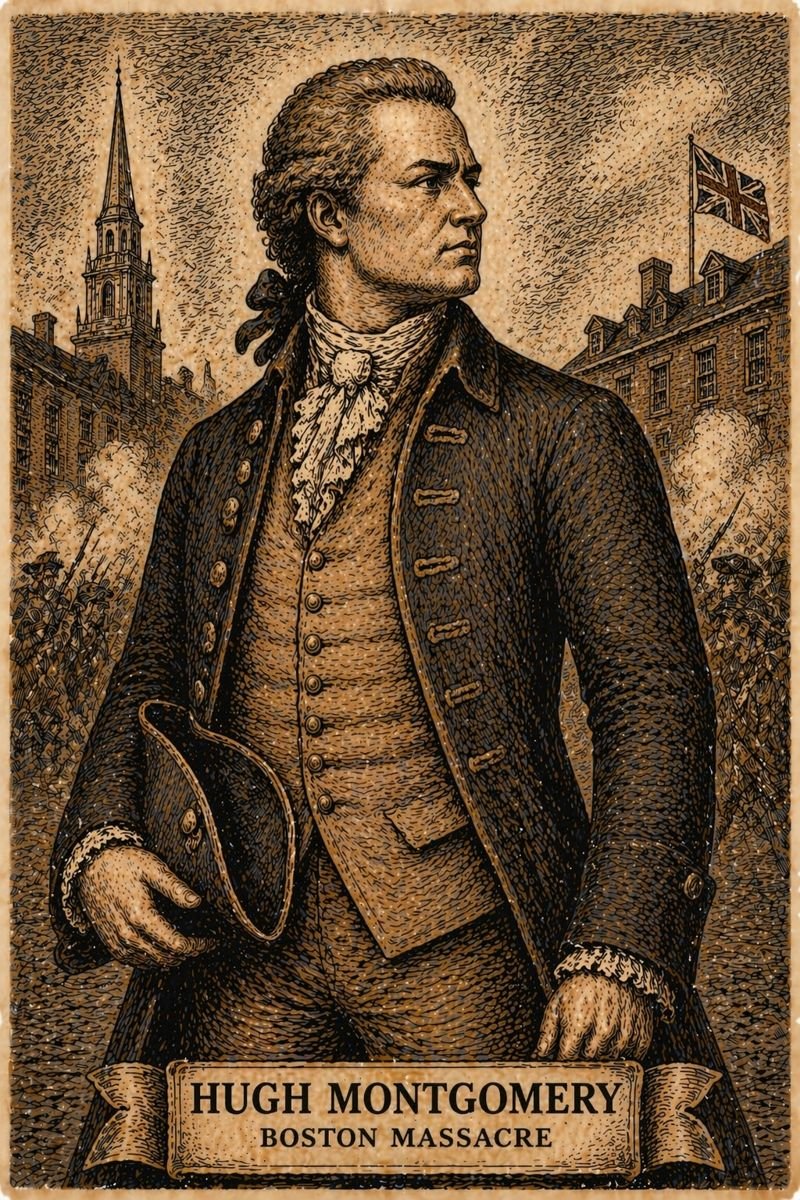 Hugh Montgomery was one of the key individuals directly involved in the Boston Massacre, and his actions on the night of March 5th, 1770, became central to both the
immediate incident and the legal proceedings that followed it. As a private soldier in the 29th Regiment of Foot, Montgomery was not a decision-maker in the broader
political conflict between Britain and the American colonies, yet his role in the confrontation placed him at the heart of one of the most consequential moments of
the pre-revolutionary period/era.
Hugh Montgomery was one of the key individuals directly involved in the Boston Massacre, and his actions on the night of March 5th, 1770, became central to both the
immediate incident and the legal proceedings that followed it. As a private soldier in the 29th Regiment of Foot, Montgomery was not a decision-maker in the broader
political conflict between Britain and the American colonies, yet his role in the confrontation placed him at the heart of one of the most consequential moments of
the pre-revolutionary period/era.
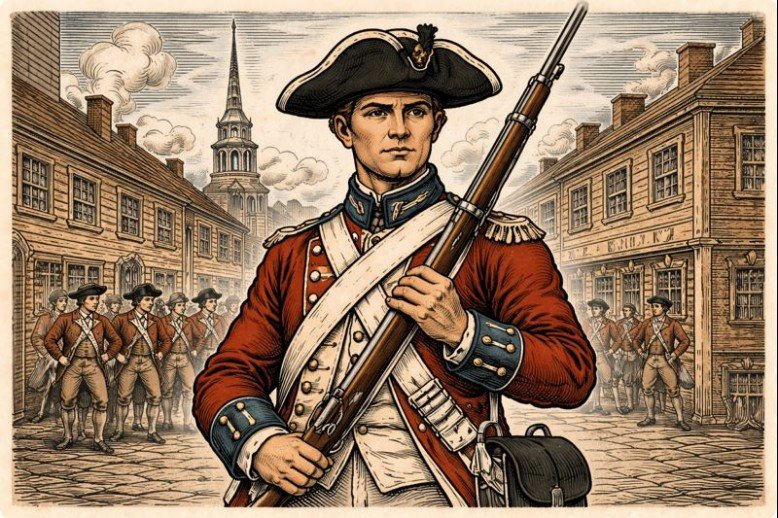
On the evening in question, Montgomery was part of the small group of soldiers led by Captain Thomas Preston who were called to assist Private Hugh White outside the Custom House on King Street. By the time Montgomery and the others arrived, the situation had already escalated. A growing crowd of colonists had gathered, shouting insults, issuing threats, and throwing snowballs, ice, and debris at the soldiers. The situation was chaotic, with noise, confusion, and rising hostility making it difficult to maintain order.
According to several accounts, Montgomery was struck by a projectile, possibly a snowball, piece of ice or a club etc., causing him to fall or stumble. It was at this point that he discharged his musket, becoming one of the first soldiers to fire into the crowd. Whether this was a deliberate act, a reflexive response to being hit, or the result of fear has been the subject of historical debate. However, many contemporary witnesses and later interpretations suggest that his shot may have been responsible for triggering the subsequent volley fired by the other soldiers.
Montgomery’s actions were therefore pivotal in transforming a tense standoff into a deadly confrontation. While it remains unclear whether the soldiers fired in response to a command or acted independently, Montgomery’s discharge is often seen as the moment when violence became unavoidable. His role illustrates how quickly events could escalate in such a charged environment, where individual reactions could have far-reaching consequences.
In the aftermath of the massacre, Montgomery was arrested along with the other soldiers involved and charged with murder. His trial, like that of his fellow soldiers, became a focal point for debates about responsibility, self-defense, and the nature of the confrontation. He was defended by John Adams, who argued that the soldiers had been provoked and had acted in fear for their lives.
Montgomery was ultimately found guilty of manslaughter rather than murder. This distinction was significant, as it acknowledged that he had unlawfully caused death but under circumstances that reduced his culpability. Instead of facing execution, he was branded on the thumb, a common punishment for manslaughter at the time. This outcome reflected the jury’s attempt to balance accountability with an understanding of the chaotic and threatening conditions under which the situation/incident had occurred.
Montgomery’s relevance to the Boston Massacre lies in the way his actions embody the chaotic dimension of the event. He was neither a senior officer nor a political leader, but an ordinary soldier placed in an extraordinary situation. His experience highlights the pressures faced by individuals operating in a chaotic environment, where fear, anxiety, and confusion could lead to irreversible consequences.
In the broader historical narrative, Hugh Montgomery’s actions represent the moment at which tension turned into tragedy. His shot, whether intentional or instinctive, helped ignite an incident that would be remembered far beyond its immediate circumstances. Through his role, we can better understand how the Boston Massacre unfolded not as a premeditated act, but as a moment shaped by human reactions under extreme pressure, with lasting implications for the relationship between Britain and its American colonies.
Samuel Adams
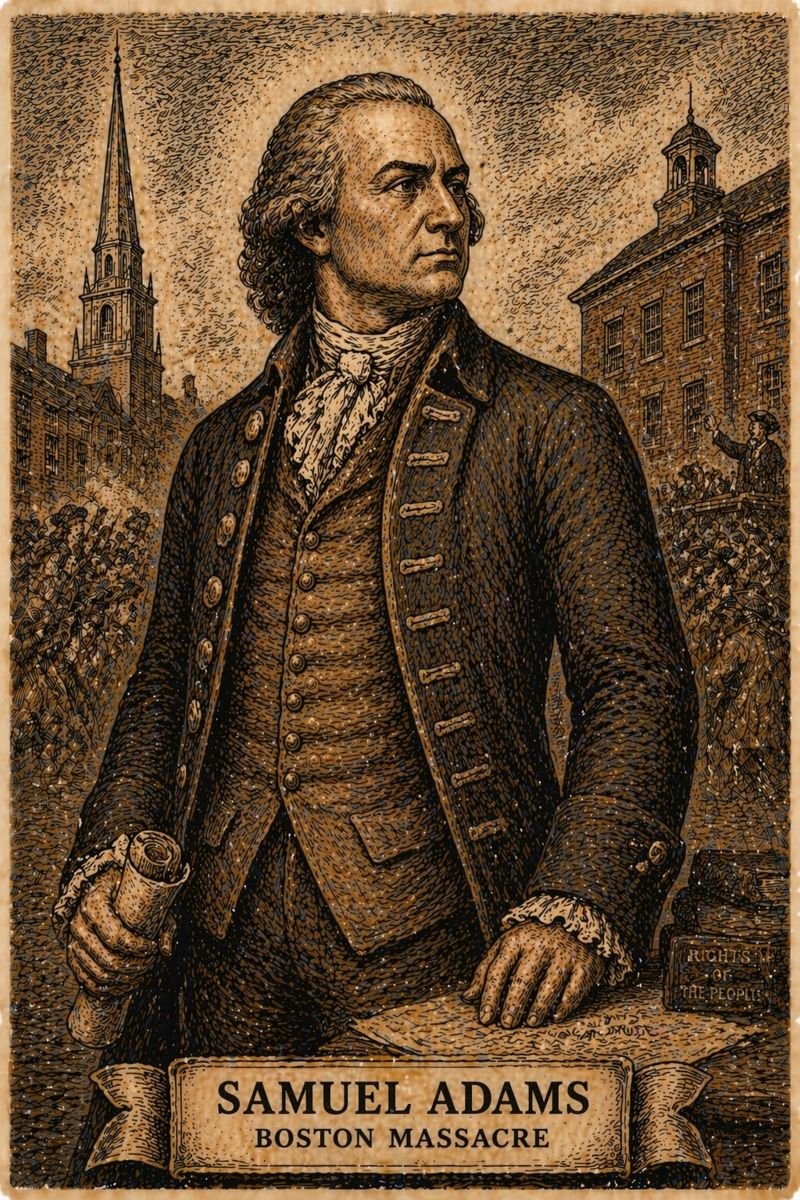 Samuel Adams was one of the most influential figures in shaping the political meaning and legacy of the Boston Massacre. Although he was not physically present at the
scene on March 5th, 1770, his role in organizing resistance, managing the aftermath, and framing the event in the public imagination made him central to its
historical significance.
Samuel Adams was one of the most influential figures in shaping the political meaning and legacy of the Boston Massacre. Although he was not physically present at the
scene on March 5th, 1770, his role in organizing resistance, managing the aftermath, and framing the event in the public imagination made him central to its
historical significance.
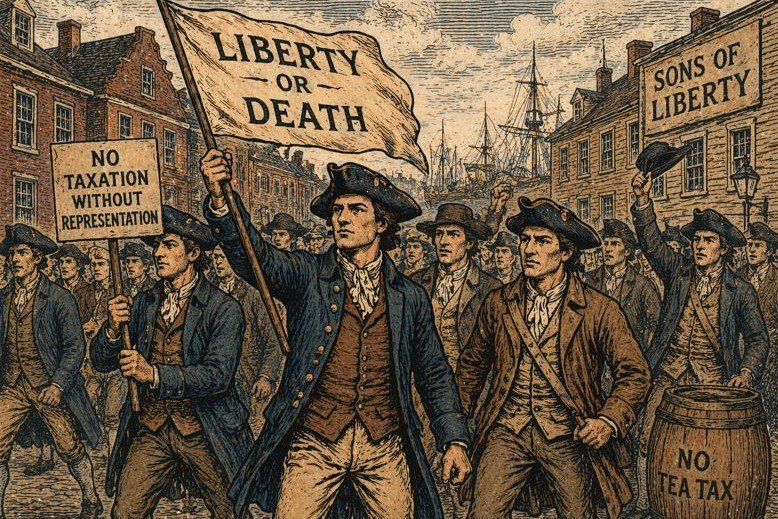
By the late 1760s, Adams had already established himself as a leading voice of opposition to British policies. He was deeply involved in protests against measures such as the Stamp Act and the Townshend duties, and he played a key role in organizing colonial resistance in Boston. As a prominent member of the Sons of Liberty, Adams helped coordinate boycotts, protests, and political messaging that challenged British authority. His ability to mobilize public opinion and unify disparate groups made him a formidable political strategist.
In the tense atmosphere leading up to the Boston Massacre, Adams had been instrumental in criticizing the presence of British troops in the city. He argued that a standing army in a civilian population was both unnecessary and dangerous, and he consistently framed the soldiers as symbols of oppression. While he did not incite the specific confrontation that led to the massacre, his rhetoric contributed to a broader climate of resistance and suspicion toward British authority.
Following the shootings, Adams moved quickly and decisively. Recognizing the potential for further violence, he worked to calm the immediate situation whilst simultaneously ensuring that the event would not be forgotten or minimized. One of his most important actions was pressing for the removal of British troops from the center of Boston, a demand that was ultimately met. This helped to prevent additional clashes and demonstrated his ability to combine political pressure with practical outcomes.
At the same time, Adams understood the importance of controlling the narrative and using it as propaganda. He helped organize the publication of accounts that portrayed the massacre as an unprovoked attack on innocent colonists. These narratives were disseminated through pamphlets, newspapers, and speeches, shaping how the event/incident was perceived both locally and across the colonies. By framing the incident as evidence of British tyranny, Adams ensured that it would become a powerful symbol of the dangers posed by imperial rule.
Adams’s influence extended beyond immediate propaganda. He also supported the decision to provide the accused soldiers with a fair trial, recognizing that the legitimacy of the colonial cause depended on adherence to principles of justice. This balance, condemning British actions whilst upholding legal standards, was crucial in maintaining credibility and attracting broader support (especially from France).
Over time, Adams played a key role in institutionalizing the memory of the Boston Massacre. Annual commemorations were organized, featuring speeches that reinforced the narrative of colonial victimhood and British aggression. These events kept the massacre alive in public consciousness and linked it to ongoing grievances about taxation, representation, and governance. Through this process, the massacre was transformed from a single event/incident into a lasting symbol of resistance.
Samuel Adams’s relevance to the Boston Massacre lies in his ability to interpret and amplify its meaning. He did not fire a weapon or stand in the crowd, but he shaped how the event was understood and remembered. His leadership ensured that the massacre would not be seen as an isolated incident, but as part of a broader struggle for rights and self-determination. In this way, Adams exemplifies the role of political leadership in revolutionary movements. By combining organization, communication, and strategic thinking, he helped turn a tragic situation into a unifying force that strengthened the push toward independence.
Paul Revere
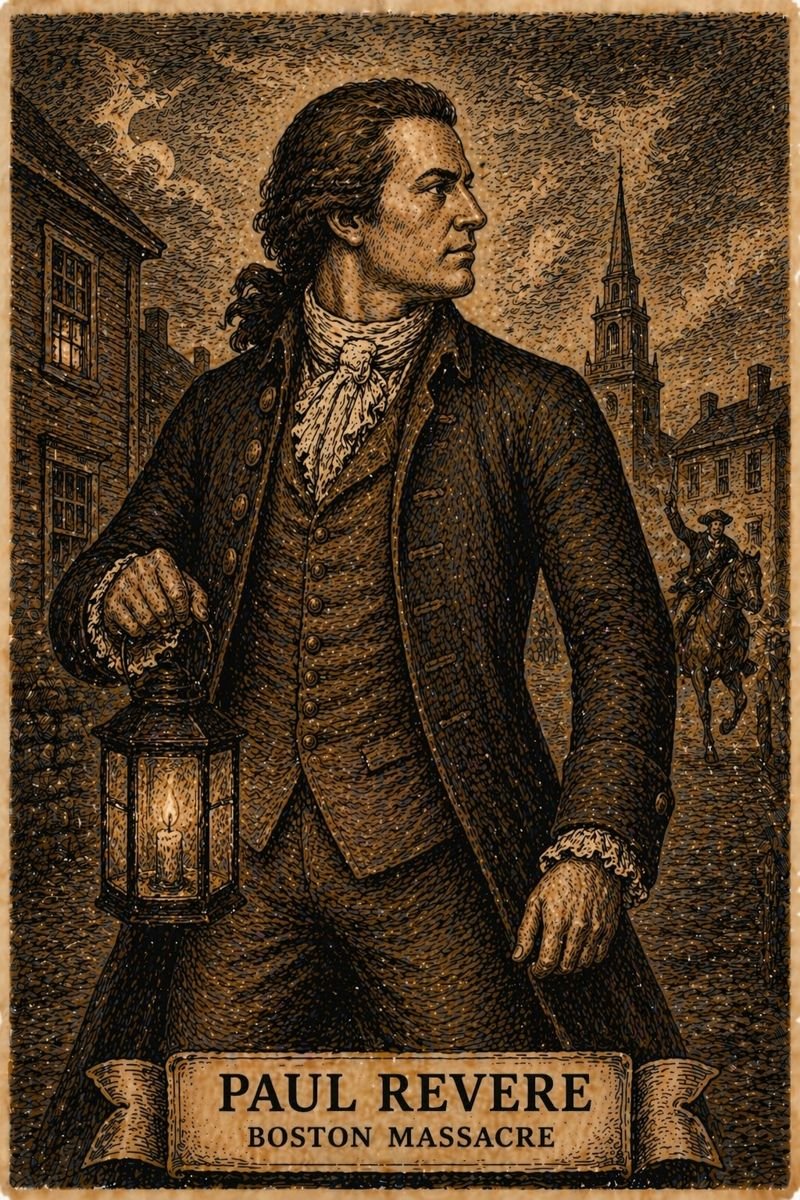 Paul Revere played a pivotal role in shaping how the Boston Massacre was understood,
remembered, and used as a political tool in the years leading up to the American Revolution. Although he was not a central figure in the confrontation itself, his
contribution lay in how he transformed the event into powerful propaganda that galvanized colonial resistance.
Paul Revere played a pivotal role in shaping how the Boston Massacre was understood,
remembered, and used as a political tool in the years leading up to the American Revolution. Although he was not a central figure in the confrontation itself, his
contribution lay in how he transformed the event into powerful propaganda that galvanized colonial resistance.
Revere was a skilled engraver and a prominent member of Boston’s artisan community, as well as an active participant in the patriot movement. He was closely associated with groups such as the Sons of Liberty and was deeply involved in opposing British taxation and authority. His dual role as both craftsman and political activist placed him in a unique position to influence public opinion through visual media.
In the immediate aftermath of the Boston Massacre, Revere moved quickly to produce one of the most famous images of the event: his engraving titled “The Bloody Massacre Perpetrated in King Street.” This image became one of the most influential pieces of propaganda in colonial America. It depicted British soldiers standing in a neat, disciplined line, firing a coordinated volley into a crowd of unarmed and passive colonists. The scene was orderly and deliberate, suggesting that the soldiers had acted with intent rather than in confusion or self-defense.
The reality of the Boston Massacre was far more chaotic. The confrontation involved a hostile crowd, thrown objects, and a tense, rapidly escalating situation. By simplifying and reshaping these details, Revere created a clear and emotionally compelling narrative. His engraving removed ambiguity and replaced it with a stark contrast between innocent victims and oppressive soldiers. This was not an objective record but a carefully constructed interpretation designed to provoke outrage.
Revere’s engraving was not entirely original; it was based heavily on an earlier image created by Henry Pelham. However, Revere’s version was produced and distributed more rapidly, allowing it to reach a wider audience. His ability to disseminate the image quickly was crucial, as it ensured that his interpretation would dominate public perception before alternative accounts could take hold.
The impact of Revere’s work was significant. His engraving was reproduced and circulated throughout the colonies, appearing in newspapers, pamphlets, and other printed materials. For many colonists who had not witnessed the event, this image became their primary understanding of what had occurred. It reinforced existing grievances against British authority and helped to unify colonial sentiment around a shared sense of injustice.
Beyond the engraving itself, Revere’s broader involvement in the patriot cause also contributed to his relevance. He was part of a network of activists who coordinated resistance, shared information, and organized responses to British policies. His later role in warning colonial militias of British troop movements in 1775 further underscores his importance in the revolutionary movement, though it was his work following the Boston Massacre that first established his influence on a wider scale.
Revere’s contribution highlights the power of imagery and communication in shaping historical events. The Boston Massacre might have remained a localized and ambiguous confrontation, but through his engraving, it became a symbol of British tyranny. This transformation was not incidental; it was a deliberate effort to influence how people thought and felt about the incident/event.
In this sense, Paul Revere’s relevance lies not in direct participation in the violence, but in his ability to define its meaning. By turning a complex and chaotic incident into a clear and compelling visual narrative, he helped ensure that the Boston Massacre would play a lasting role in the movement toward revolution.
Josiah Quincy II
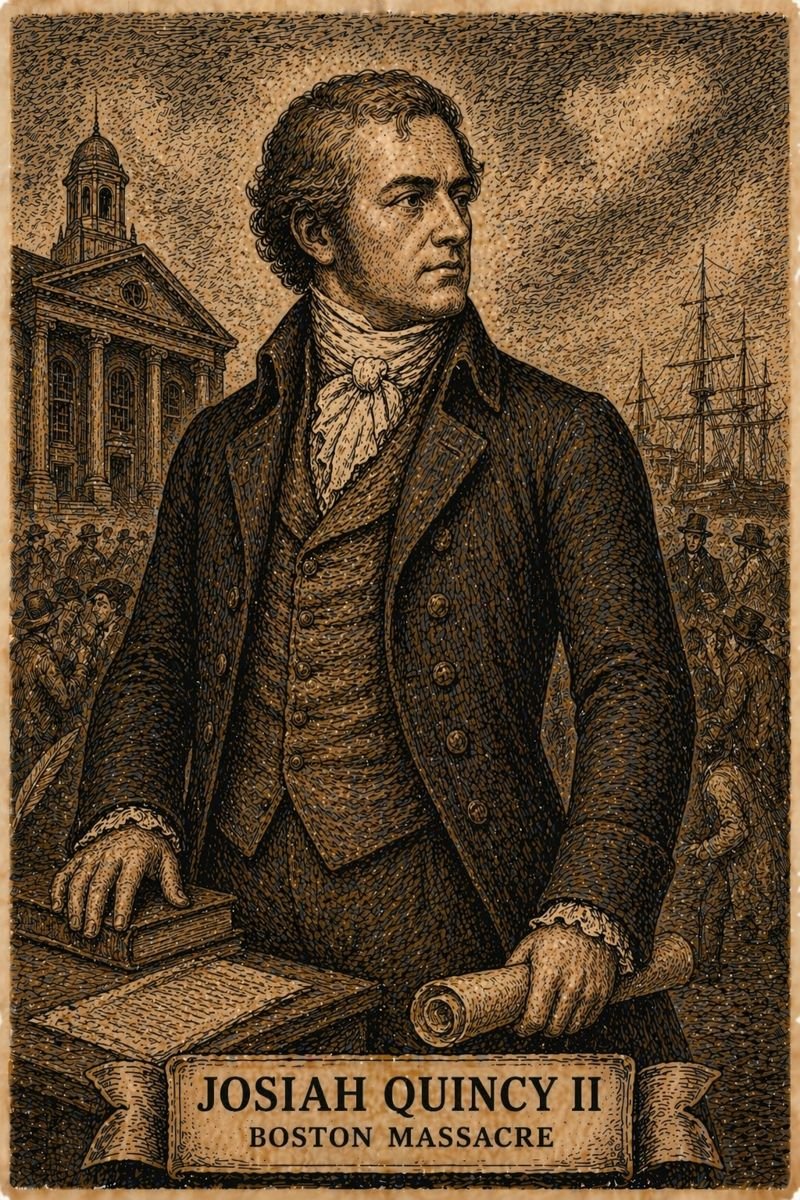 Josiah Quincy II played a significant, if sometimes overlooked, role in the aftermath of the Boston Massacre. As a young lawyer and committed patriot,
Quincy’s involvement in the legal defense of the British soldiers highlighted the complexity of the colonial response to the incident and underscored the
importance placed on justice, even in a highly charged political environment.
Josiah Quincy II played a significant, if sometimes overlooked, role in the aftermath of the Boston Massacre. As a young lawyer and committed patriot,
Quincy’s involvement in the legal defense of the British soldiers highlighted the complexity of the colonial response to the incident and underscored the
importance placed on justice, even in a highly charged political environment.
By 1770, Quincy had already established himself as an outspoken critic of British policies. He opposed measures such as the Townshend duties and was aligned with the broader patriot movement in Boston. His writings and speeches reflected a strong commitment to colonial rights and resistance to what he viewed as unjust governance. Given these views, his decision to assist in the defense of British soldiers accused of killing colonial civilians might appear contradictory at first glance.
However, Quincy’s actions were grounded in a principled belief in the rule of law. Alongside John Adams, he agreed to represent the soldiers in court, despite the unpopularity of such a decision. In the wake of the massacre, public sentiment in Boston was overwhelmingly hostile toward the British troops. Taking on their defense exposed Quincy to criticism and potential personal risk, as many colonists viewed the soldiers as symbols of oppression.
Quincy himself recognized the tension between his political convictions and his professional duties. He reportedly described his decision as one that would cost him dearly in terms of reputation, but one that was necessary to uphold justice. For Quincy, the legitimacy of the colonial cause depended not only on opposing British policies but on demonstrating a commitment to fairness and legal integrity. If the colonists were to argue that British rule was unjust, they needed to show that they could administer justice more equitably.
During the trials, Quincy contributed to the legal arguments that sought to establish that the soldiers had acted in self-defense. The defense emphasized the chaotic nature of the confrontation, the danger faced by the soldiers, and the difficulty of maintaining control in such a volatile situation. Whilst not all observers agreed with this interpretation, the legal process itself was conducted with a level of care that reinforced the credibility of the colonial legal system.
The outcome of the trials, acquittals for most of the soldiers and reduced charges for others, reflected the jury’s willingness to consider the evidence rather than simply respond to public outrage. Quincy’s role in this process was crucial, as it helped ensure that the proceedings were not merely symbolic but genuinely deliberative.
Beyond the courtroom, Quincy’s involvement carried broader significance. It demonstrated that the patriot movement was not solely driven by emotion or hostility, but also by a commitment to principles that would later become central to American identity. His actions helped to counter British claims that the colonies were lawless or incapable of self-governance, providing a practical example of how justice could be administered fairly even under pressure.
Josiah Quincy II’s relevance to the Boston Massacre therefore lies in his embodiment of a key tension within the revolutionary era: the balance between resistance and restraint. He was both a critic of British authority and a defender of British soldiers, illustrating that the pursuit of independence was intertwined with the development of legal and moral standards.
In this way, Quincy’s legacy extends beyond the specific act of defending the soldiers. His willingness to act according to principle, even when it was unpopular, contributed to the broader effort to define what American justice would look like. His role in the aftermath of the Boston Massacre serves as a reminder that the incident wasn’t only about political change but also about establishing enduring ideals of fairness and due process.