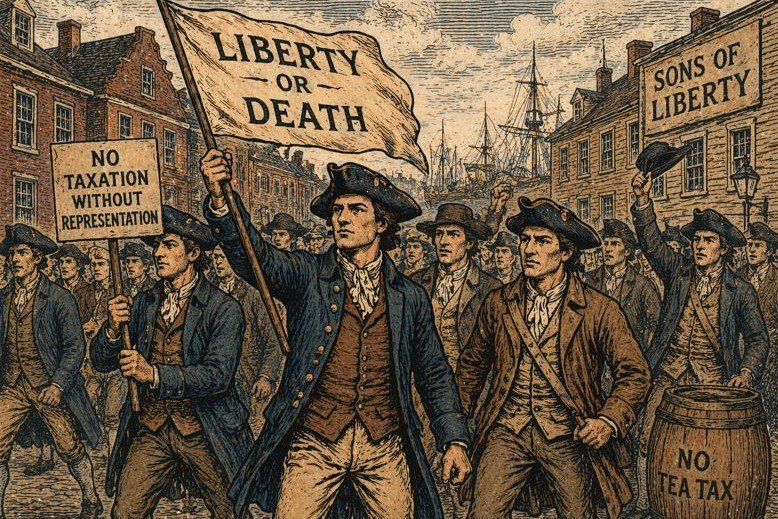
The Boston Massacre was one of the most significant and symbolic events in the lead-up to the American Revolution. Occurring on the evening of March 5th, 1770, in Boston, Massachusetts, the incident was the culmination of years of rising tension between British authorities and colonial residents. Whilst relatively small in scale, resulting in the deaths of only five colonists, it had an outsized impact on public opinion and colonial resistance.
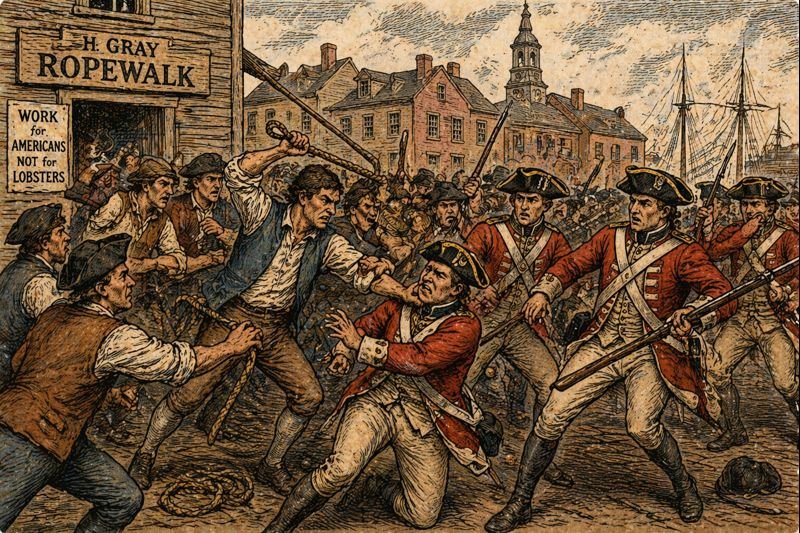
The events began with a seemingly minor confrontation. A British sentry, Private Hugh White, was stationed outside the Custom House on King Street (now State Street), a focal point for colonial resentment due to its association with tax collection. Earlier in the evening, White became involved in an altercation with a young apprentice, and tensions quickly escalated as a crowd began to gather. Colonists hurled insults at the soldier, calling him derogatory names and challenging his presence. What started as verbal harassment soon intensified, with members of the crowd throwing snowballs, ice, and debris.
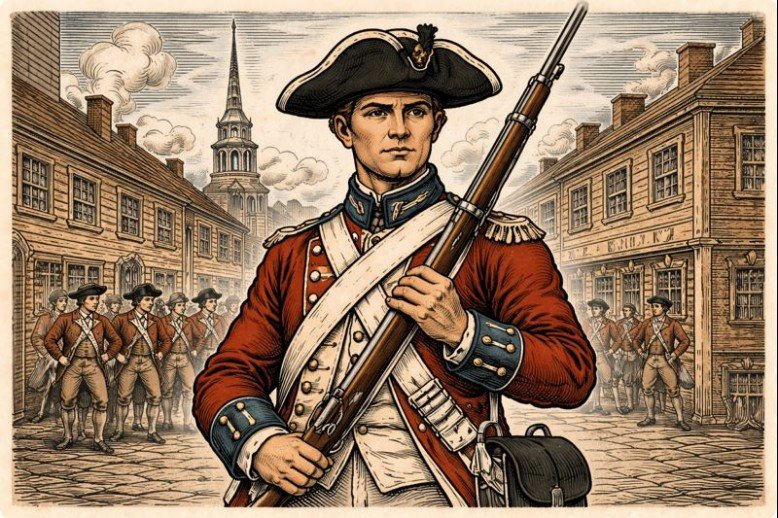
As the situation grew more volatile, White called for reinforcements. Captain Thomas Preston arrived with a small detachment of soldiers from the 29th Regiment of Foot. By this point, the crowd had grown significantly, numbering dozens and possibly more. The colonists pressed in on the soldiers, continuing to shout and throw objects. The soldiers, for their part, stood in a defensive formation, their muskets loaded and bayonets fixed, facing an increasingly hostile group at close range.
What happened next remains a matter of historical debate. Amid the chaos, one of the soldiers fired his musket. Whether this was in response to being struck, a misinterpretation of an order, or a moment of panic is unclear. Other soldiers quickly followed, discharging their weapons into the crowd. In the confusion and smoke, several colonists fell. Five men would ultimately die from their wounds, including Crispus Attucks, a sailor of African and Native American descent who is often regarded as the first casualty of the American Revolution.
The immediate aftermath of the shooting was marked by shock and outrage. The crowd dispersed, and local authorities moved quickly to restore order, aware that further violence could erupt. British officials, including the acting governor, sought to defuse the situation by removing troops from the center of the city. At the same time, patriot leaders began to organize their response, recognizing the political significance of the event.
Amongst the notable figures associated with the Boston Massacre were both those directly involved in the confrontation and those who shaped its interpretation. Captain Thomas Preston and the soldiers under his command were arrested and charged with murder, reflecting the seriousness with which colonial authorities treated the incident. On the colonial side, individuals such as Samuel Adams played a key role in managing the political response, while Paul Revere helped shape public perception through his famous engraving of the incident.
Revere’s image, which depicted British soldiers firing in a coordinated volley at an unarmed crowd, became one of the most enduring representations of the massacre. Although it simplified and distorted the complexities of what actually happened, it was highly effective as propaganda, reinforcing the narrative of British oppression. This portrayal helped galvanize colonial opinion and ensured that the massacre would be remembered not as a chaotic street fight but as a deliberate act of violence.
The legal proceedings that followed further highlighted the significance of the incident. The soldiers were given a fair trial, defended by John Adams, who argued that they had acted in self-defense. Most of the soldiers were acquitted, with only two convicted of manslaughter. This outcome demonstrated a commitment to due process, even in the face of intense public anger, and became an important example of colonial legal principles.
Despite the relatively limited number of casualties, the Boston Massacre had a profound impact on the relationship between Britain and the colonies. It crystallized existing grievances and provided a powerful symbol of the dangers of British rule. The presence of troops in Boston, once justified as a means of maintaining order, was now widely seen as a threat to colonial liberty.
In the years that followed, the massacre was commemorated annually and used as a rallying point for resistance. It became part of a broader narrative that linked taxation, military occupation, and political suffering into a single cause. Whilst it didn’t immediately lead to the subsequent revolutionary war, it played a crucial role in shaping the attitudes and beliefs that would eventually make conflict unavoidable.
In this way, the Boston Massacre stands as both a tragic event along with a turning point. It revealed how quickly tensions could escalate into violence and how such violence could be transformed into a powerful force for political change.