To be a British soldier stationed in Boston in the late 1760s was to live in a constant state of tension, caught between duty to the Crown and daily hostility from the civilian population. These soldiers, often referred to as “redcoats” for their distinctive uniforms, were not elite warriors or political actors, but largely ordinary men drawn from Britain’s working classes. Many had enlisted out of economic necessity rather than patriotism, seeking steady pay, food, and shelter in a society where employment opportunities were limited.
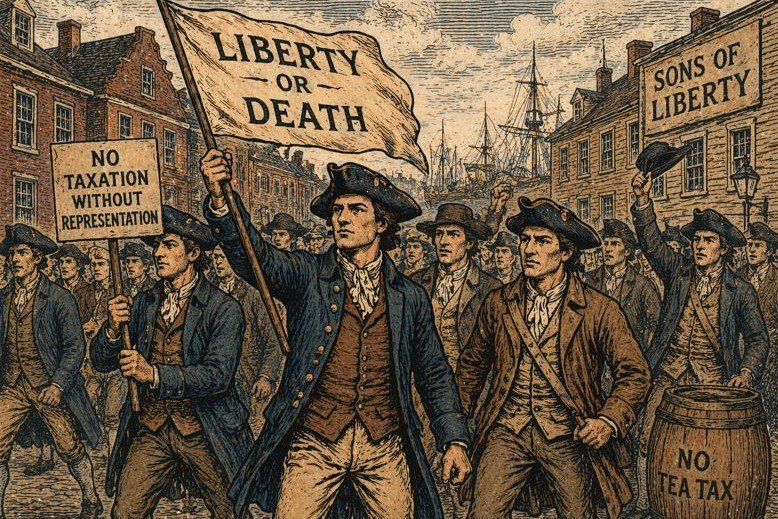
When regiments were deployed to Boston in 1768, following rising unrest over taxation and customs enforcement, they entered a city that already viewed them with suspicion. From the perspective of British authorities, their presence was intended to maintain order and enforce imperial law. However, for many Bostonians, the arrival of troops signaled occupation. A standing army in peacetime was widely seen as a threat to liberty, and the soldiers became visible symbols of a perceived British overreach.
Daily life for these soldiers was far from comfortable. Barracks were often inadequate, and some troops were quartered in public buildings or private homes, further aggravating local resentment. Pay was low and frequently delayed, making it difficult for soldiers to support themselves. In response, many sought off-duty employment in the city to supplement their income. This was a common and practical solution from the soldiers’ point of view/perspective, but it placed them in direct competition with local laborers, who already struggled with inconsistent work and wages.
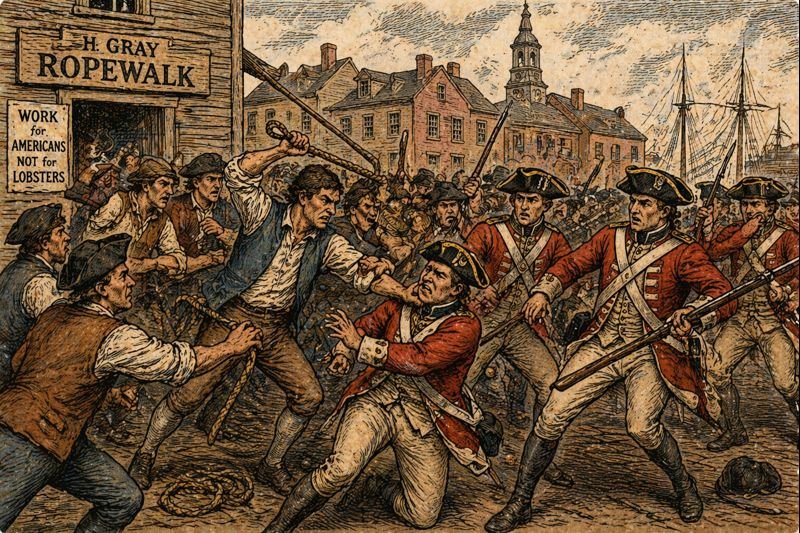
This economic friction became one of the underlying causes of escalating violence. Boston’s workforce, particularly artisans and dockworkers, saw soldiers taking jobs as an unacceptable intrusion. The tension wasn't purely political; it was personal and immediate. Arguments over employment could quickly turn into physical confrontations, fueled by mutual resentment and a lack of trust.
These dynamics were clearly evident in the ropewalk fights of early 1770. Ropewalks, were large, open-air facilities used for making rope essential to maritime trade, and were important sites of employment in Boston. When British soldiers sought work at these establishments, they were often met with hostility from local workers. What began as verbal exchanges escalated into a series of violent clashes over several days. Soldiers and civilians fought with fists, clubs, and improvised weapons, drawing in larger crowds and deepening the divide between the military and the population.
For the soldiers involved, these confrontations were not necessarily ideological battles but immediate struggles for dignity, income, and survival. They were often outnumbered and found themselves targeted not just as individuals but as representatives of British authority. At the same time, their training and discipline, designed for battlefield conditions, were ill-suited to managing volatile civilian – non-military - encounters. The result was a cycle of provocation and retaliation, where each side interpreted the other’s actions as aggressive and unjustified.
By the time of the Boston Massacre on March 5th, 1770, relations between British soldiers and civilians had deteriorated significantly. The incident itself began with a relatively minor dispute but quickly escalated as a crowd gathered around a British sentry. Insults, threats, and thrown objects created a chaotic and threatening environment. Reinforcements arrived, and in the confusion and fear, shots were fired into the crowd, killing five colonists.
whilst the event was widely portrayed in colonial propaganda as a deliberate massacre, the reality was somewhat more complex and nuanced. The soldiers involved were placed in a highly volatile situation, facing a hostile crowd in close quarters. Their decision to fire, whether commanded or spontaneous, reflected a breakdown of control under intense pressure. This does not absolve them of responsibility, but it does highlight the human factors at play: fear, confusion, and the difficulty of maintaining discipline in the face of perceived danger.
In the aftermath, the soldiers were both condemned and defended. Notably, they received legal representation from Johm Adams a cousin of Samuel Adams, who argued that they had acted in self-defense. Most were acquitted, reinforcing the idea that the situation had been more ambiguous than initial accounts suggested.
To view British soldiers solely as instruments of oppression risks oversimplifying their experience. They were, undeniably, part of an occupying force enforcing unpopular laws, and their presence contributed to the conditions that led to violence. Yet they were also individuals navigating a difficult and often hostile environment, trying to make a living far from home in a city that largely rejected them.
Their story, particularly in the lead-up to the Boston Massacre, is one of competing pressures, economic, social, and political, that converged in a moment of tragedy. Understanding their perspective does not diminish the grievances of the colonists, but it adds depth to the narrative, revealing how ordinary people on both sides became entangled in a conflict that would ultimately lead to revolution.